
Featured Article
The Natural Religion of Humanity
Exploring fitrah, humility, and the God-centered values that shape Muslim matrimony, halal marriage, and sincere faith.

Fitrah, Humility, and the Search for Truth
The Natural Religion of Humanity begins with a core insight: humility opens the path to truth, while arrogance blinds the heart. In seeking the truth, humility is an ally and arrogance is your enemy. We humans are not as rational as we would like to believe. Even in matters as objective as scientific research, subjectivity is the norm; data supporting personal opinion is treated favorably compared to ‘anomalies’ and ‘outliers’. We tend to view relevant evidence through the prism of our viewpoint, distorting and qualifying so it can be rendered acceptable. Thus, two people with similar intelligence, aptitude and formal education may study the same subject – biochemistry of liver cells, to use one example – with one person seeing the beauty of divine creation and the other seeing proof that there is no god. The same data, analysis tools and high intelligence … yet diametrically opposite conclusions. So why is that?
In fact, each individual has a point of view into which he or she assimilates new information.
Ibrahim and Divine Unity
We don’t use facts to derive conclusions, as much as use information to reinforce our opinions. To put it uncharitably, the result is often a foregone conclusion without our being aware of this fact. Rather like language, which is picked up at an astonishingly early age and with remarkably limited instructions, humans brains are programmed to create and reinforce a personal world-view from an early age. Each new piece of information or experience is used to shape this worldview, which, once in place, uses new data to reinforce itself. Thereafter, it is very difficult to displace ... rather like unlearning your mother tongue, to use a simple example. Other factors that influence opinion include family pressure to conform, financial incentives, persistent marketing of ‘facts’ via news media, and professional reputation to name a few. However, just because we believe in something doesn’t make it true. There are infinite many paths forward from where you stand, but only one straight path to your destination. This straight path is unique and also the most difficult to stay on. Humility is the first step on this path, absolute sincerity is the next, and perseverance is the third. Are you prepared to take these steps? One person who searched for the straight path thousands of years ago was Ibrahim (Abraham). Ibrahim’s answer was simple … the natural religion of humanity is to proclaim divine unity and submit to the will of the One God (Allah, Alaha, Elaha, Elohim). These two acts - profession of faith and sincere submission - together represent the natural and eternal religion of humanity. Allah is the Raab (or Master), and the human submitting to the Divine Will is an abd. Just as darkness is defined as the absence of light and does not have its own independent identity, abd is defined solely in contrast to Raab, and is meaningless without. Consequently, the noblest name and the highest station for human being is to be an abd of Allah (or abd-Allah).
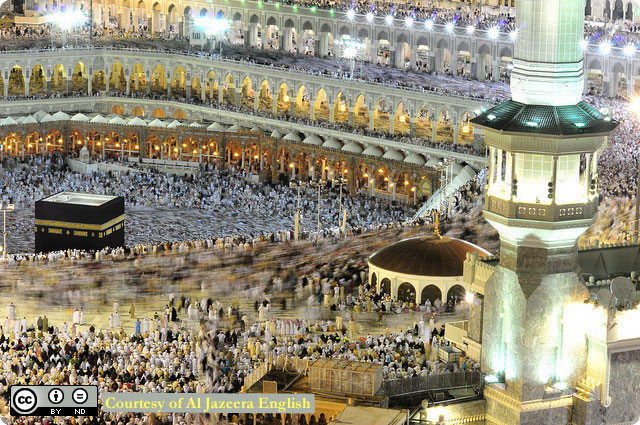
In addition to being an abd of Allah, Ibrahim had the singular honor of building the very first house of worship on Earth - a mystical black cube adorned in gold and surrounded by white circles moving in the stillness of the desert night. It is binding on those having the necessary health and the financial means, to travel to this house once in their lifetime. As a side note, Ibrahim's blood flows through most people living today - in the Jewish people through Ishaaq, in the Arabs and Hispanics through Ismail, and also in the Aryans (note the in the words Braham-an and Abraham) that spread across Asia and Europe, to name a few.
Submission, Taqwa, and Human Responsibility
Proclaiming divine unity means throwing out the window all notions of holy family trees, multiple divine personas and anthropomorphism (the divine taking human or animal form). Less obvious, but just as important is the widespread submission to lesser gods … we say there is only one God, but then elevate select human beings to the point that divinity is shared for all practical purposes. If someone came to you today and claimed that he or she was the Almighty, would you accept it? If not, why accept it regarding someone who lived two thousand or five thousand years ago? Divine unity is the most obvious and fundamental of all truths, and represents the core of true faith. If a person could accept just one thing to the exclusion of all else, it would be this one fact.
Faith in divine unity has a natural consequence and that is complete submission to the Almighty. We mentioned four categories of negating divine unity in the previous paragraph. With appropriate effort one can largely avoid these pitfalls on the path of true faith. Unfortunately, there is a fifth category that is notoriously difficult to overcome and it is personal ego and desires. It is human frailty to make personal preferences a god, as opposed to the divine. We covered this previously, when we first mentioned the rider and the imperative in not becoming a slave of the donkey. In this regard, Ibrahim has such a lofty station that Allah bestowed divine friendship upon him. Ibrahim was once asked why he had been given such a high status. He mentioned three things in his response and one of which was, “When I have to do or say something, or otherwise choose a course of action, I look at all possible options and choose the one that will please Allah the most.” Try following the example of Ibrahim for just a few hours or days, and you can measure your ability to stay on the true path.
When submission to Allah becomes an overpowering truth informing every moment and every aspect of a person’s life, such a person has attained a state of peace called islam. A person who attains this inner peace is called a muslim, both words being rooted in the Semitic consonants: s-l-m (which gives as other words such as shalom). Submission is an act and therefore a verb. To think of it as a noun implies designation and election, which is the path of arrogance and the antithesis of Ibrahim’s simple message. Moreover, an uncompromising adherence to divine unity is to be a ‘hanif’. A person fulfilling both requirements is a hanif-an-muslimun. Such an individual recognizes that the Ruh represents divine moral authority, carrying a trust given to none other. This sense of responsibility and awareness (taqwa) informs every facet of life – worship, livelihood, family ties, charity, service and activism – and is rewarded with eternal success. It is uncompromisingly egalitarian … every human being stands on an equal footing before divine majesty and justice, with none allowed to carry the burden of, or answer for the actions of another. Conversely, those who reject the divine trust by deceiving and exploiting others will face a grievous reckoning. Between the extremes poles of taqwa and kafr are those who meander through life, generally distracted by self-interest, but not lowered to abject wickedness and corruption. These individuals are squandering a wonderful gift and will ultimately look back with profound regret. Alas, there will be no going back. Allah called Ibrahim a hanif-al- muslimun. And the path of Ibrahim represents a role model for every messenger that followed him … from Musa (Moses) to Isa (Jesus) to Muhammad … may Allah shower His blessings and mercy on all of them.
Whether a person is born today on the shores of Lake Baikal in Siberia or walked forty thousand years ago along the Mediterranean Sea, he/she stands on an absolutely equal footing with every other in terms of working to become a ‘hanif-al-muslimun’. Your ethnicity, the religion of your family and friends, your physical attributes give you not an iota of superiority over any another human being. Nor do you need to approach Allah through another human being, formal religious institution or other medium. This is because all human being have been given a gift … and that gift is called Ruh. The truth lies with us, waiting to be discovered.
Returning to the Natural Religion of Humanity
Human error stems ultimately not from wickedness, from forgetfulness. Every messenger or prophet in human history has come to remind us of this divinely-endowed moral responsibility and to lead a life consistent with this station. Doing so is to follow in the footsteps of Ibrahim, and to return to the natural religion of humanity.
For additional context, see Tawhid (divine unity) and Quran translations.
Explore more on Nikah4Life
Looking for a faith-centered relationship? Visit our Muslim matrimony search, join via the registration page, learn how Nikah4Life works, read Ten Thousand Religions, continue with The Search for God, compare with The Lonely Traveler, view the home page, or contact us on the contact page.