
Featured Article
A Message from God
Understanding divine revelation and the Islamic guidance that shapes Muslim matrimony, family life, and everyday faith.
Revelation in the Cave of Hira
A Message from God begins with the first revelation and the call to read in the name of Allah. Fourteen hundred years ago, a forty-year-old man sat in a dark mountain cave. This individual was a family man and an established merchant who traded along the Red Sea route between Palestine and Yemen. He was known for his outstanding moral character, trustworthiness and generosity. In recent years, he had become distraught at the injustices around him - exploitation of slaves, burial of infants due to poverty, worship of rough stone idols and senseless tribal fighting. This man was a hanif – a person that innately recognizes and turns to one God. Nevertheless, he was unsure of the path of salvation. He started withdrawing from the community, coming occasionally to a mountain cave in order to meditate. On one such night, like a bolt of lightning striking across the darkness, and with similarly overwhelming contrast, came a divine revelation. Five ayahs or oral signs ended a five hundred and eighty year hiatus going all the way back to the time of Isa (Jesus), the messenger of Allah. Humanity is commanded: “Read (this revelation) in the name of your Lord who created all creatures. Created each human from a tiny clot of blood. Read, for your Lord is unsurpassed in His generosity. For He taught humanity with the (written script) pen. Taught humanity that which it did not know (revelation, script and knowledge).”
Thus came the command: “Read (this revelation) in the name of your Lord who created life. Who created each human from a tiny clot of flesh. Read, for your Lord is unsurpassed in His generosity. He taught humanity with the (written script) pen. Taught humanity that which it did not know (revelation, script and knowledge).” For divine generosity is grounded in knowledge and wisdom granted to humanity. It is exemplified by the gift of speech and writing, giving us mastery over the physical world. Writing is a metaphor for creation – bringing forth knowledge from the ocean of unknowns – as the ink scribes across the blank sheet. Nevertheless, privilege must be accompanied by profound humility in order to achieve this innate potential. And the revelation reminds us of the same by recalling the insignificant origin of life. Arrogance, above all, is the source of downfall. When we claim - who needs the Creator and divine laws? Or when we declare – I know what is best for me and my family. But divine generosity necessitated another reminder as humanity entered its last epoch. And revelation thundered in the darkness of a remote mountain cave, irresistible and beyond all measure.
The Early Quranic Message and Moral Reform
Overwhelmed by this spiritual experience, Muhammad bin Abdullah tumbled down the mountain and rushed home, fearing that he was possessed, or crazy, or worse. He described what had happened to Khadija, his wife of fifteen years and the mother of their three daughters. As fifteen years his senior, she was also his best friend and advisor. Khadija assured Muhammad, may Allah be pleased with him, that he was most sensible and balanced person she had ever known in her fifty-five years. She also took him to her cousin, a Nestorian monk, for advise. The old man told the messenger of God that the people of Mecca would reject him. Sure enough, as news spread across the community, people generally decided that this was a clearly a case of insanity. However, there was a small minority that claimed that this man also known as Saadiq (the truthful one) and Ameen (the trustworthy one) would not be stop to lying. Some months passed by and the matter subsided gradually. Then came the second revelation - seven ayahs (literally signs from the divine) – later placed at the start of Surah al Qalam (a chapter called the Pen):
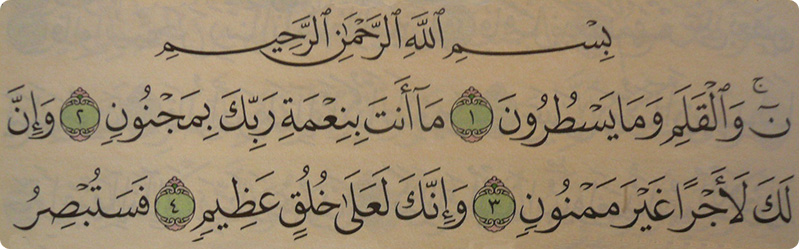
Here, Allah swears by the pen - a symbol of the eternal record, the written decree and divine governance – that the recipient of this divine revelation is not mad. If anything, only people of the highest moral caliber are worthy of receiving divine signs. Theirs will be a path of great adversity, but the rewards will also be unending. The prophet is also commanded to not make any compromise in the matter of faith – divine unity and submission. This revelation also highlights the eternal decree and singles out charity as a key test of true faith. It gives the example of a farmer who gave significant portion of his crops to the needy. When he died, his children decided that they would not follow in their father’s footsteps. At harvest time, they decided to get to work early and wrap things up before poor people could gather and ask for a share. In doing so, they neglected to acknowledge divine will and decree. That night, a raging wind destroyed the field. As such, when they arrived the following morning, they initially suspected that they had lost their way. Later, when they realized their mistake, they repented and asked Allah for forgiveness. As such, this revelation reminds humanity to not follow the path of greed, as all bounty belongs to Allah alone. Those who transgress will face punishment in this life so they may repent. However, if the matter is deferred, reckoning in the hereafter will be more severe. As such, the divine message encourages humanity to acts of charity and in seeking forgiveness from Allah in all matters.
Preservation of the Quran Through Oral and Written Chains
The third revelation soon followed with the prophet being addressed affectionately by Allah, and receiving clear instructions to rise and convey a sobering reminder to humanity that if they do not act righteously, they will face a fearful reckoning from Allah on the last day. The emotive style of speech is unlike any the Arabs had ever seen. They were revealed in oral form over a period spanning twenty three years. Totaling over six thousand in number, the ayahs were neither poetry nor prose, having a sublime beauty unlike anything previously encountered. Generally, the ayahs came down in small sets numbering three to ten, with successive revelations separated by gaps of days or weeks. Their subject matter varied from current issues to historical events and predictions of events yet to come. There were accounts of the unseen world, guidance on personal piety, political and social matters. Moreover, there was an exhortation to reflect, learn and remember the hour of death and act in a positive manner. This qur’an (or speech) was memorized by the desert Arabs to whom they were sent, and has since passed via an unbroken chain from one generation to the next to reach the present time. The huffaz (keepers of the trust) have grown in number over successive generations with at least a million of them being our contemporaries. Given that the divinely revealed speech takes about fifteen hours to recite at a normal pace, it is remarkable that a significant minority of huffaz are non-Arabs. Given the prodigious learning skills in childhood, most huffaz complete their memorization in their pre-teen years, and it is common to find huffaz that only nine or ten years old. In short, the divine speech is by far the most widely known and accurately transmitted oral tradition in human history.
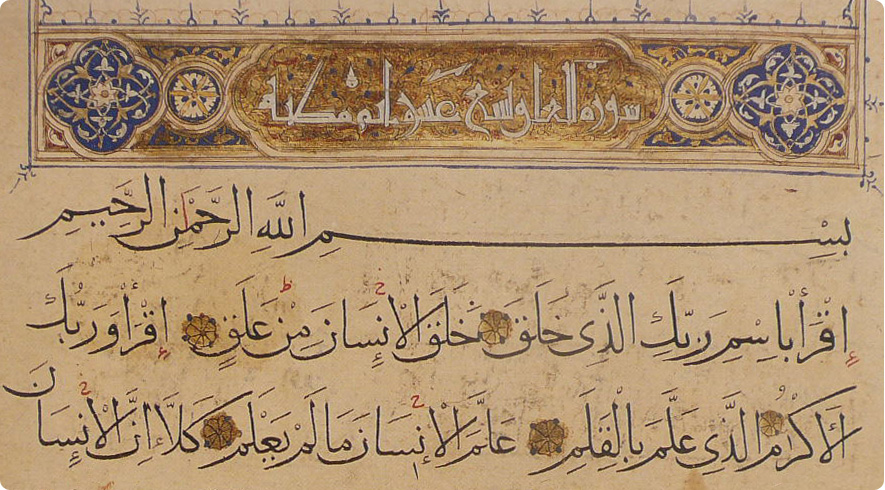
Although the primary mode of transmission of the qur’an is oral - from the hearts of one generation of huffaz to the next - written copies has also been used since the earliest days to facilitate memorization and for use by non-huffaz. As such, several copies from the first century Hijri are available in places such as Sana’a, Istanbul, Tashkent and Cairo. In particular, some of the manuscripts discovered in the great mosque of Sana’a following heavy rains in 1965, have been carbon dated to about 1400 years old and conform to estimates made using paleographic techniques. The earliest copies were written Hejazi and Kufic scripts with little by way of diacritic marks and dots. Nevertheless, they are remarkably easy to follow if you have memorized the text or are otherwise familiar with it. To illustrate this fact, I have provided one example below from a first Hijri manuscript by selecting a couple of lines and added the modern font for comparison:
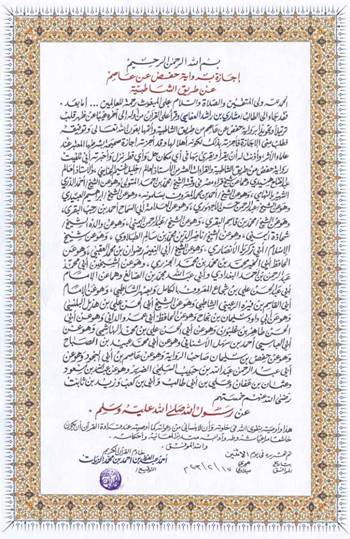
The serious students, however, still learn the entire oral tradition from a master, who in turn learnt from his or her master, and so on going back to the time of the revelations fourteen hundred years ago. Graduating huffaz are typically checked by at least two masters before being awarded an ijazah (certificate of permission to transmit to the next generation). A copy of a typical ijazah is included below for illustration purposes. It has only 32 generations between the recipient of the ijazah and the messenger of God. This is because of a strong bias towards keeping the chains as short as reasonable possible so masters often teaching students that were forty to fifty years younger than them. A similar trend was seen in the hadith literature where each generation focused on their grandchildren to preserve the line of learning.
It is important to note that the qur’an is not a book, but revealed speech and its written form must be read and understood as such. As an example, the order of revelation is not reflected in the written form. In general, a number of the earliest revelations have been collected towards the end of the written text, while the latter ones are to be found closer to the beginning. While this was not an issue from a memorization perspective, it did mean that the earliest scribes would have to erase and rewrite or previously used folios, or find new paper to complete their work. To use one example, the very last revelation of all is in Surah Baqarah (Chapter of the Heifer), ayat number 281, which was revealed about one week before the death of the messenger of God on 12 Rabi al- Awal in the 11th year of the Hijra (632 CE). This ayah is as follows:
Following this ayah, Surah Baqarah has another five ayahs that had previously been revealed including the longest ayah in the Qur’an – ayah number 282 – which is also included below to give you a flavor for some of the shuffling people had to do for the written text. One interesting example of the former category is the example below, again from southern Arabia from the first half of the first Hijri where a lighter text can be seen on the same manuscript even after it was erased and the paper was reused. The e As such, if all the books are wiped out today, the divine message is able to pass to the next generation with ease. Entire art forms, both verbal and written has also sprung around the qur’an (or speech) revealed to humanity to our Creator. The very first seven signs are called fatiha (or opening) and represent the most often repeated words ever repeated. Click on the link or download to hear what the seven divine signs sound like. They are words of rare beauty and sublimity, representing the essential relation between the creator (One) and the created (one), unencumbered by any intermediary. translate loosely into the following:
All the praise belongs to the owner of all creation
The most beneficent and the most merciful
Master of the day of reckoning
You alone do we worship and you alone do we call for strength
Lead us on the true path (the single most important prayer of all)
The path of those You showered with your blessings
Not the path of those who incurred Your wrath and the ones who are misguided
(ameen)
Ultimately, the Quran is full of priceless guidance from our Creator. Who would know us better than the One who sent us into this world in the first place? Accepting the message of Islam and Quran is the key to inner peace, regardless of the storms that are raging in the world around us. We recognize that hardship is part of the test of worldly life, with eternal ease and plentitude in the hereafter for those who how patience, fortitude and discipline before death. After we die, the book of actions is firmly closed, while the book of recompence stretches forward forever. Will we not recognize the gravity of our present situation and act accordingly?
For additional context, see Quran overview and Quran translations.
Explore more on Nikah4Life
Looking for a faith-centered relationship? Visit our Muslim matrimony search, join via the registration page, learn how Nikah4Life works, read The Search for God, continue with The Lonely Traveler, compare with The Natural Religion of Humanity, view the home page, or contact us on the contact page.